Cuatrecasas Legal SLP

Evidence of Receipt by Cuatrecasas Legal SLP

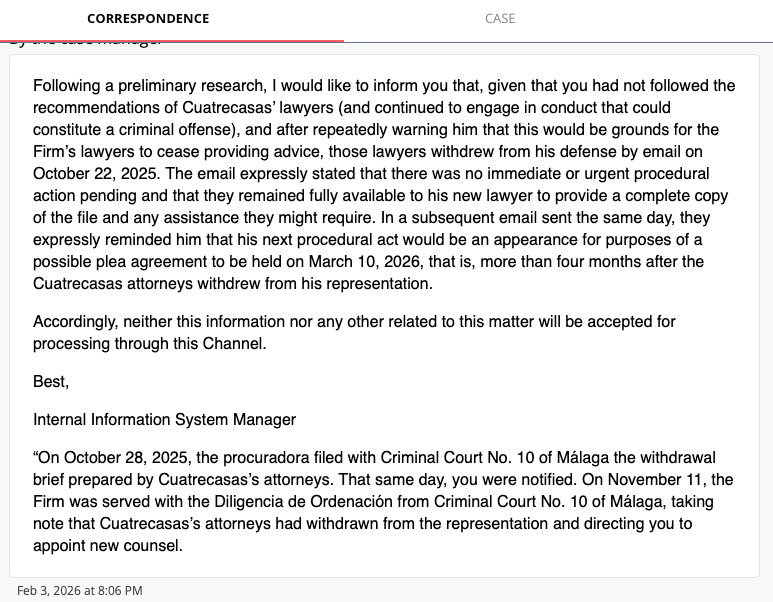
I hereby submit a complaint regarding Cuatrecasas’ representation of me in private criminal proceedings in Málaga Province between May and October 2025, in particular concerning advice not given and why the firm withdrew from representation. I am acutely aware that Cuatrecasas cannot be responsible for procedural failures that occurred before it was retained. However, during the period of representation and upon withdrawal, the firm failed to identify, advise upon, or respond appropriately to matters that are critical to integrity of legal profession.
Failure to address or advise on expansion of charges: Although expansion of alleged offences (from two possible offences to eight counts) occurred during 2nd period of defencelessness and prior to Cuatrecasas’ 9k€ retainer, it is clearly apparent in case file. I was never advised that such an expansion had occurred, nor was I advised as to its legality or proportionality, nor was any challenge raised. If this expansion was identified internally but not communicated to me or to the court, that would raise extremely serious ethical concerns. If it was not identified at all, that too is deeply troubling.
Failure to advise on rejection / neutralisation of defence evidence (July 2025): In July 2025, defence evidence was filed on my behalf (*Escrito de medios de prueba*, with annexes). I was informed that a so-called “vista de conformidad” was scheduled for March 2026 (8 months into an imagined future). At no point was I informed by Cuatrecasas that the defence evidence submitted in July 2025 had, in fact, been procedurally rejected or neutralised by the court as being “out of time”, nor that it would not be admitted as evidence at trial. On the contrary, I was left with the understanding that this evidence had been properly submitted and would form part of my defence. I only later discovered—through direct examination of court notifications—that the evidence had been expressly declared inadmissible for procedural reasons. This omission deprived informed decisions at a decisive stage.
Failure to advise on or invoke art. 11.2 LOPJ: Before, throughout and beyond Cuatrecasas’ period of representation, proceedings exhibit multiple cumulative indicators of procedural abuse (defective notifications, defence discontinuity, evidentiary foreclosure) disguised as privately-driven criminal actions unsupported by any Public Prosecutor. Despite this, I was never advised about the existence, scope, or potential applicability of article 11.2 of the Ley Orgánica del Poder Judicial, nor was any attempt made to invoke it before any court. Given that art. 11.2 imposes a mandatory, ex officio safeguard against abuse of procedural rights and fraud of law, I find this omission difficult to understand.
Withdrawal from representation and ensuing defencelessness: When Cuatrecasas withdrew from representation, I was informed that if I did not appoint new counsel, two would be appointed ex officio. More than three months elapsed, yet no defence counsel is appointed—by me or by the court. I am again in a prolonged situation of defencelessness whilst facing fraudulent criminal proceedings. Cuatrecasas’ withdrawal may have formally banked its retainer, but the firm has shown no apparent concern for the fact that its withdrawal has contributed to a renewed and ongoing deprivation effective defence.
Stonewalling regarding “vista de conformidad”: I was informed that a conformity hearing had been scheduled, but when I raised concerns about 1948 Universal Declaration of Human Rights implications of this procedural posture—in circumstances where evidence is excluded and no Public Prosecutor is accusing—I received guidance: “If you wish to overturn this decision your only option is to pay the amounts requested by the Court”.
Kind regards,
Graeme Walker

Side-notes, observations (as of 20 January 2026): 83 separate “Ilustre Colegios de Abogados” (independent bar associations) appear to exist in Spain. Each illustrious college simultaneously performs two incompatible functions: trade unionism (defending personal interests of members) and professional regulation (investigating poor performance and disciplining unethical conduct by members). Every practising lawyer in Spain must - by law - subscribe to one of these 83 Ilustre Colegios, despite inherent structural impotence at professional regulation (trade unionism trumps professional ethics when both functions are confined to a single entity). A national council of bar associations (Consejo General de la Abogacía Española) exists, but lacks competence to investigate poor performance or unethical conduct by individual lawyers. No systematic disclosure of “Ilustre Colegios de Abogados” memberships appears within Cuatrecasas’ online lawyer biographies.